
Percentage Difference Calculator
Compare two numbers the right way. The percentage difference compares two values relative to their average — useful when neither is the “original”. Percentage change measures an increase or decrease from an old value to a new one. Enter two values and the calculator shows both, plus the absolute difference and, for percentages, the difference in percentage points.
- Free to use
- No sign-up
- Runs in your browser
Percentage difference calculator
Percentages Practice & Reference Pack
Printable percentage formulas sheet, percentage difference and change worksheets with answer keys, a percentage points explainer and an Excel comparison workbook.
- Formulas sheet (PDF)
- Difference & change practice (PDF, DOCX)
- Comparison workbook (XLSX)
- Reporting checklist (PDF, DOCX)
Formats: PDF, DOCX, XLSX. Instant download after payment (link valid 72 hours, up to 5 downloads). AI-assisted: the templates were drafted with AI help and reviewed and laid out before publishing.
$5.00 USD, one-time 4 files · about $1.25 each
- Instant download
- 7-day refund
- Secure checkout by Stripe
7-day money-back guarantee. Full refund within 7 days of purchase, even after you download.
Free sample: Comparison Workbook (PDF, 83 KB)
Full refund within 7 days — see the refund policy and license.
Free printables
Single sheets you can print right now, no sign-up. The full pack adds every sheet in one download plus the editable files.
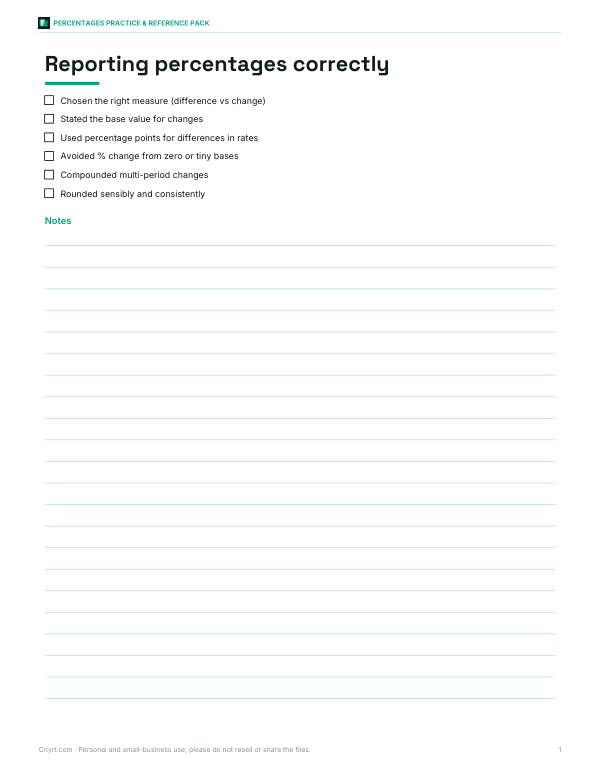 Reporting Percentages Checklist
Percentage difference vs percentage change
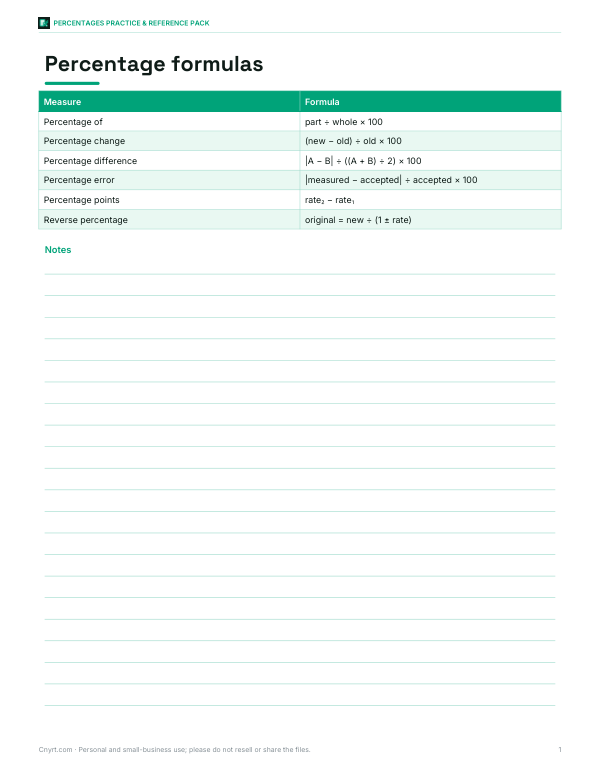
Percentage difference = |A − B| ÷ ((A + B) ÷ 2) × 100. It treats the two values symmetrically, comparing their gap to their average, so it gives the same answer whichever value you list first. Use it when comparing two measurements of equal standing — two shops’ prices, two lab measurements, two methods. Percentage change = (new − old) ÷ old × 100. It has a direction (increase or decrease) and depends on which value is the starting point. Use it for changes over time: last year to this year, before to after.
Worked example: 45 and 60
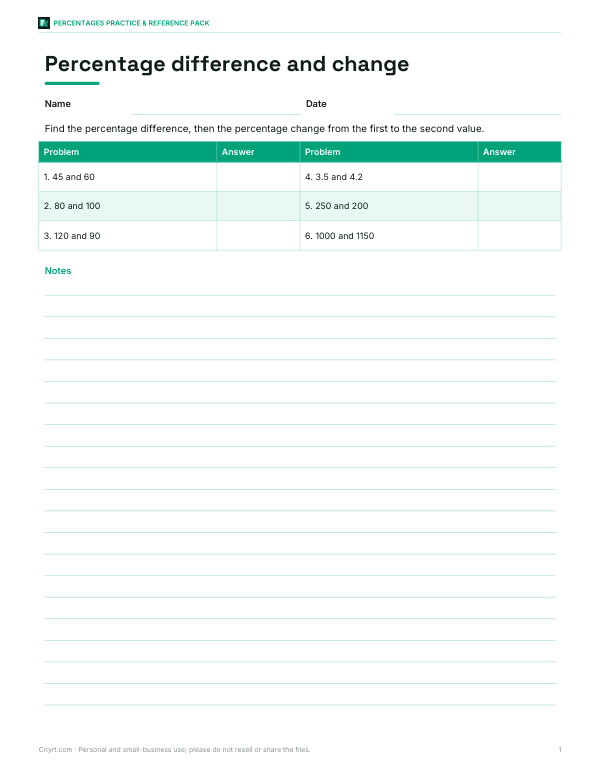
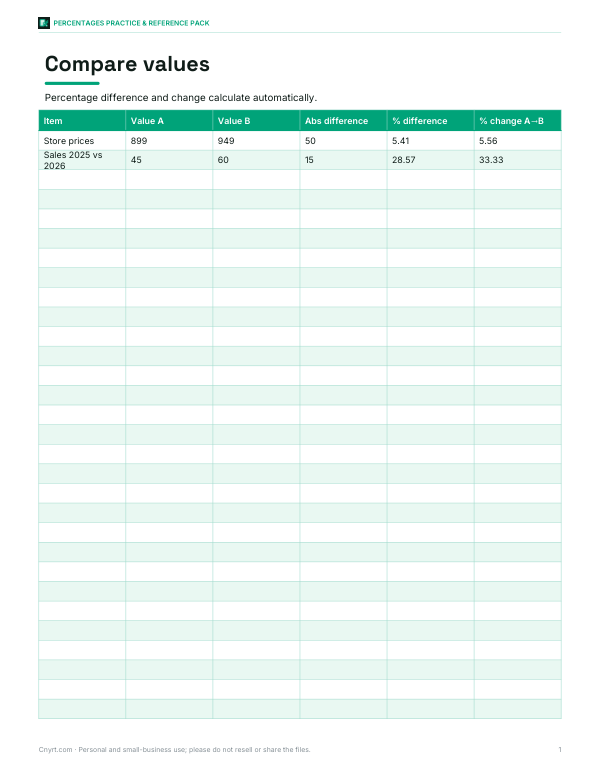
The absolute difference is 15 and the average is 52.5, so the percentage difference is 15 ÷ 52.5 × 100 = 28.57%. If 45 was last year’s value and 60 this year’s, the percentage change is (60 − 45) ÷ 45 × 100 = +33.33%. Going the other way, from 60 down to 45, is (45 − 60) ÷ 60 × 100 = −25%. The three numbers differ because they use different reference values — which is exactly why it matters which one you report.
Percentage points
When the values being compared are themselves percentages, say “percentage points” for the simple difference. If an interest rate rises from 4% to 5%, it has increased by 1 percentage point, which is a 25% increase in the rate. Confusing the two is one of the most common errors in news and reports. Tick “values are percentages” to see both.
Where each measure is used
- Science and engineering — percentage difference compares two experimental results or a measurement with a second method; percentage error compares a measurement with an accepted value: |measured − accepted| ÷ accepted × 100.
- Business — percentage change for growth in sales, costs and prices over time.
- Shopping — percentage difference to compare prices at two stores; percentage change for a price that went up or down.
- Statistics and polls — percentage points for changes in shares and rates.
Common mistakes
- Calling a percentage change a “percentage difference”, or vice versa.
- Using the wrong base: an increase of 50% followed by a decrease of 50% does not return to the start (100 → 150 → 75).
- Adding percentage changes over several periods instead of compounding them.
- Reporting percentage change when the starting value is zero or very small — the result is undefined or misleadingly huge.
- Mixing percentage points with percent changes.
Percentage error
Percentage error is a close relative used in labs: it compares your result with a known or accepted value. If the accepted value of g is 9.81 m/s² and you measured 9.62, the percentage error is |9.62 − 9.81| ÷ 9.81 × 100 = 1.94%. Unlike percentage difference, it uses the accepted value as the reference because that value is treated as correct.
Negative numbers and zero
Percentage difference uses absolute values in the average, so it stays meaningful for negative numbers, but interpreting a percentage difference between values of opposite sign is rarely useful. Percentage change is undefined when the starting value is zero — you cannot divide by zero — and becomes misleading when the start is very close to zero. In those cases report the absolute change instead.
Worked example: comparing prices
A laptop costs $899 at one store and $949 at another. Neither price is the original, so percentage difference is the natural measure: |949 − 899| ÷ 924 × 100 = 5.41%. If the first store raises its price from $899 to $949 next month, that is a percentage change of +5.56% — a slightly different number, because the base is $899 rather than the average.
Relative size in everyday language
Headlines often say one thing is “three times more” or “200% more” than another, which can be ambiguous. If A is 100 and B is 300, B is 200% more than A (a percentage change of +200%) or three times as much as A (a ratio of 3). The percentage difference between them is 100%, because the gap of 200 is equal to their average of 200. Stating the actual values alongside the percentage avoids confusion.
Averages of percentages
Be careful when averaging percentage changes. If prices rise 10% one year and 20% the next, the total increase is not 30% but 1.10 × 1.20 − 1 = 32%. The average yearly growth is the geometric mean: (1.32)^(1/2) − 1 ≈ 14.9%, slightly less than the simple average of 15%. For long periods and larger changes the gap grows, which is why investment returns are reported as compound annual growth rates.
Privacy
The calculator runs in your browser; nothing is stored or uploaded.
Frequently asked questions
How do you calculate percentage difference?
|A − B| divided by the average of A and B, times 100.
What is the difference between percentage difference and percentage change?
Percentage difference compares two values symmetrically; percentage change measures an increase or decrease from an old value.
Is percentage difference the same both ways?
Yes, it does not depend on the order of the values.
What is a percentage point?
The simple difference between two percentages, e.g. 4% to 5% is +1 percentage point.
Why does +50% then −50% not return to the start?
Each percentage uses a different base: 100 → 150 → 75.
Is my data stored?
No, it runs in your browser.
Can percentage difference be more than 100%?
Yes, up to 200% when one value is much larger than the other, for example 1 and 100 differ by about 196%.
Which is bigger, percentage change or percentage difference?
For an increase, percentage change from the smaller value is larger than the percentage difference; for a decrease it is smaller.